How to Think Like a Writer: 5 Lessons from the Literary Masters
What separates a great writer from an amateur is not just a talent for vocabulary; it is a fundamental way of seeing the world. By adopting the psychological habits of literary masters—like obsessive observation, radical honesty, and relentless discipline—anyone can learn the craft of storytelling.
While spending months curating the essays and letters of history’s greatest authors for the Classic Inspirational Quotes compendium, I realized that “writing” is rarely about the physical act of typing. It is about how you process reality before you ever touch a keyboard. Great writers are professional “noticers” and disciplined craftsmen. Here are the five core mental frameworks I extracted from the masters that will teach you exactly how to think like a writer.
The Writer’s Toolkit: 5 Timeless Lessons
Lessons from the literary masters on craft, honesty, and discipline.
1. Lesson: Observe: Be a “Professional Noticer”
“Don’t tell me the moon is shining; show me the glint of light on broken glass.” – Anton Chekhov
This is the number one rule of all creative writing: “Show, Don’t Tell.” Most people tell (“It was a sad day”). A writer shows (“The rain streaked the dusty windowpane”). To be a writer, you must become an obsessive observer of the small, specific, sensory details that everyone else ignores. Finding that “glint of light on broken glass” communicates more emotion than a full page of heavy-handed exposition.
2. Lesson: Be Honest: Write the “Truest Sentence”
“All you have to do is write one true sentence. Write the truest sentence that you know.” – Ernest Hemingway
Amateurs often try to sound “like a writer” by using convoluted metaphors and complex sentence structures. Hemingway’s advice is the exact opposite: be radically, brutally honest. Cut through the fluff. Find the one thing you know to be true, and say it as simply as possible. This is the ultimate cure for writer’s block, and it is the only way to build a powerful, authentic voice.
3. Lesson: Be Human: Find the Universal in the Specific
“By writing about the specific, you touch the universal.” – Core Literary Principle
Why do we still care deeply about a 19th-century woman in a bonnet (Jane Austen) or a paranoid Scottish king (Shakespeare)? Because these authors wrote about highly specific characters with such psychological honesty that they revealed universal truths about love, jealousy, pride, and power. Never try to write vaguely about “humanity.” Write about one person, in one specific moment, and you will tell a story for everyone.
4. Lesson: Be Precise: Find the Right Word
“The difference between the almost right word and the right word is really a large matter—it’s the difference between the lightning bug and the lightning.” – Mark Twain
A writer is an artist, and words are their paint. Mark Twain reminds us that word choice is everything. It’s not just what you say, but how you say it. Great writers are obsessed with finding the perfect word, rather than settling for the merely adequate one. This relentless precision is exactly what creates rhythm, voice, and unforgettable imagery.
5. Lesson: Be Disciplined: Just Show Up
“Amateurs sit and wait for inspiration; the rest of us just get up and go to work.” – Stephen King
This is the final, hardest lesson. Society holds a romantic idea of the writer as a “muse-driven” genius. The reality I found while researching hundreds of authors is that writing is a job. It’s a daily practice. The greatest writers (like King) are not necessarily the most naturally inspired; they are simply the most disciplined. They show up every single day, especially on the days they don’t “feel” like it. This is how you build a body of work.
More Inspirational Quotes from Famous Writers
To keep you motivated on your own creative journey, here are additional highlights extracted directly from our complete volume of literary wisdom.
Famous Quotes on the Craft of Writing
“If you don’t have time to read, you don’t have the time (or the tools) to write. Simple as that.” – Stephen King
“Tears are words that need to be written.” – Paulo Coelho
“There is no rule on how to write. Sometimes it comes easily and perfectly; sometimes it’s like drilling rock and then blasting it out with charges.” – Ernest Hemingway
Inspirational Quotes for Writers on Discipline
“You can always edit a bad page. You can’t edit a blank page.” – Jodi Picoult
“Start writing, no matter what. The water does not flow until the faucet is turned on.” – Louis L’Amour
Thinking like a writer is a skill. It’s the habit of observing, the courage of honesty, the empathy of humanity, the precision of craft, and the relentless discipline of work.
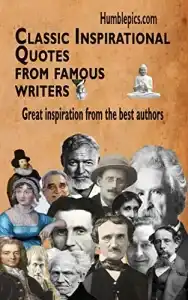
If you’re looking for the fuel to start your own practice, this analysis was inspired by the full collection in our book, Classic Inspirational Quotes from Famous Writers. You can find insights from dozens of the world’s greatest authors in our complete volume, available now in our digital collection.
Explore our complete digital bookstore collection →
To write well, one must understand the human condition. Few authors captured this better than the Bard; exploring Shakespeare’s Human Themes is essential for any writer. For a more modern take on observation and wit, we can look to Oscar Wilde’s Life Lessons.