Why We Believe Weird Things (And How to Stop)
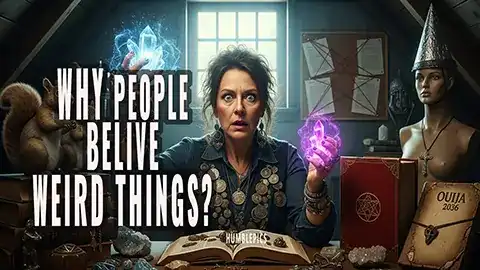
Our brains are biologically wired to find patterns, take mental shortcuts, and believe weird things. By adopting scientific skepticism—not as a cynical attitude, but as an active cognitive tool—you can outsmart your own evolutionary biases and systematically replace bad ideas with the truth.
While researching cognitive biases and the history of scientific thought for the Humblepics Book Collection, I realized that raw intelligence alone doesn’t protect us from being fooled. We are naturally easy targets for pseudoscience, “miracle” products, and outright nonsense because our brains want to find meaning where there is none. Skepticism is the mental firewall against this manipulation. Here is a breakdown of why your brain wants to be fooled, and the mental frameworks required to stop it.
Skepticism as a Way of Thinking
1. Stop Thinking of Science as a “Thing”
First, we must correct a fundamental misunderstanding. We often think of science as a “thing”—a dusty textbook, a lab coat, or a static collection of facts. That is entirely wrong.
Science is a verb. It is a process. It is a way of actively looking at the world, asking rigorous questions, and seeking out natural explanations for all phenomena. The ultimate goal of this process isn’t just to stubbornly be “right”; it is to constantly replace bad ideas with better ones. Skepticism is the engine that drives this entire process forward.
2. The Psychic’s Trick: How to Fool Yourself
Here is the absolute easiest way to fool yourself: Only count the hits and ignore the misses.
Pseudoscientists—like psychics, astrologers, and tarot card readers—are psychological masters of this. They make dozens of vague predictions in a single session. Our brains naturally forget the 99 times they are completely wrong, but we are blown away by the one time their “vision” seems to align with reality.
A true skeptic, like a good scientist, keeps a complete database. They track the hits and the misses. They then ask: Is the number of “hits” statistically better than random chance? The answer is almost always no.
A perfect historical example is the Quadro 2000 Dowser Rod. This $900 piece of plastic was sold to schools, claiming it could “dowse” for marijuana in student lockers. When finally tested in a controlled experiment (one box with marijuana, one empty), the device found the drugs 50% of the time. It performed exactly as well as a coin flip.
3. The Most Powerful Question You Can Ask
When you encounter an extraordinary claim, from a miracle medical cure to a UFO sighting, a skeptic relies on one simple, immensely powerful question:
“What’s the more likely explanation?”
Before we enthusiastically conclude that something is “out of this world,” we must first be absolutely sure it’s not in this world.
- UFOs: What’s more likely? That an advanced alien civilization traveled millions of light-years to visit us, or that a human observer made a perceptual mistake involving a weather balloon or a military drone?
- Crop Circles: Is it more likely to be a complex, encoded message from extraterrestrials, or the midnight work of clever humans with some rope and wooden boards?
This simple application of Occam’s Razor can instantly dismantle a huge amount of societal nonsense.
4. Why Your Brain Believes Weird Things
Here is the hard evolutionary truth: your brain actually wants to be fooled. We are pattern-seeking animals. This evolutionary trait helped our ancestors spot a predator’s face hidden in the bushes. Unfortunately, in the modern world, it also causes us to see:
- The “Face on Mars” (which is just a pile of rocks and shadows).
- The Virgin Mary burned into a cheese sandwich.
- Religious or demonic icons in tree bark or window condensation.
This psychological glitch isn’t limited to visual images. Our brains are “primed” to find auditory patterns, too. If someone tells you to listen for a “Satanic message” played backward in a rock song, you will absolutely hear it—even if the sound is just meaningless, reversed gibberish. Your brain creates the pattern it was primed to find.
5. Science: The Start of the Conversation, Not the End
Skepticism doesn’t mean you claim to have all the answers. It means you are comfortable relying on a better process for finding them. This is the defining difference between science and pseudoscience:
- Pseudoscience (like Intelligent Design) says, “A miracle occurred.” This is the end of the causal chain. It offers nothing to test, no further questions, and nowhere to go. It is a full stop on human curiosity.
- Science is the beginning of the causal chain. When Galileo first observed Saturn, his data wasn’t great and his initial theory was wrong. But he didn’t stop. Later, Christiaan Huygens used a better telescope (better data) and a better theory to finally solve the puzzle of Saturn’s rings.
Science is a self-correcting journey. It’s a process that works precisely because it is willing to admit when it is wrong, discard bad ideas, and replace them with the truth.
Explore our complete digital bookstore collection →
Skepticism removes bad ideas, but we must replace them with a robust framework for truth. For a defense of progress, science, and humanism in the modern age, read the Pinker & Harris Case for Reason.