The Two Sides of Power: 5 Strategies from Machiavelli and Gracián

For centuries, anyone seeking to understand, gain, or hold power has turned to one man: Niccolò Machiavelli. His work, The Prince, is the unvarnished, ruthless textbook for “hard power.”
But another, lesser-known masterpiece exists, written by a 17th-century Jesuit priest named Baltasar Gracián. The Art of Worldly Wisdom is the ultimate guide to “soft power”—a subtle, pragmatic, and psychological playbook for navigating the complex social world.
By comparing these two masters, we can get a complete picture of power. Let’s explore five strategies from these two brilliant, opposing minds.
Machiavelli vs. Gracián
A comparative guide on The Art of Power, Strategy, and Wisdom.
Lesson 01On Reputation & Appearances
Machiavelli
“It is not necessary to have all good qualities, but it is very necessary to appear to have them.”
Gracián
“The real is defined by what it contains… Be, rather than seem to be.”
The Core Divide: Machiavelli offers cynical advice where appearances are a tool. Gracián argues substance is everything; a reputation built on “seeming” is fragile.
Lesson 02On Friends & Enemies
Machiavelli
“It is better to be feared than loved, if you cannot be both.”
Gracián
“Friends are a second existence… Every friend is good and wise for his friend.”
Transactional vs. Asset: Machiavelli views relationships as transactions where fear is reliable. Gracián views friends as your greatest asset and source of wisdom.
Lesson 03On Action & Timing
Machiavelli
“Fortune is a woman… it is necessary, if you want to hold her down, to beat her and strike her.”
Gracián
“Know how to wait… Fortune gives its greatest favors to those who wait.”
Force vs. Patience: Machiavelli champions bold, violent action. Gracián teaches the power of patience, waiting for the perfect moment.
Lesson 04On Dealing with Others
Machiavelli
“He who deceives will always find someone who will allow himself to be deceived.”
Gracián
“Know how to use your enemies… A wise man gets more use from enemies than a fool from friends.”
Manipulation vs. Utility: Machiavelli sees people as pawns to deceive. Gracián suggests finding utility everywhere, using even opposition to your advantage.
Lesson 05The Ultimate Goal
Machiavelli
The goal is “to maintain his state.”
Gracián
The goal is “to become a ‘complete person’.”
External Control vs. Internal Virtue: Machiavelli aims for external political control. Gracián aims for internal self-mastery and wisdom.
Machiavelli gave us the rules of raw, political power, while Gracián gave us the art of subtle, social wisdom. To navigate the modern world, we need both.
If you enjoyed this exploration of power and strategy, it was inspired by the full collection in our book, 465 Niccolò Machiavelli and Baltasar Gracián Quotes. You can explore all 465 insights from both masters in our complete volume, available now on Amazon.
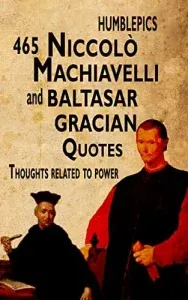
Check out our top titles on amazon!
Machiavelli and Gracián wrote the classic playbooks on strategy. In the modern era, no one has synthesized these laws better than Robert Greene. For a contemporary look at these dynamics, read Robert Greene: The Art of Power.
1. Lesson: On Reputation and Appearances
Machiavelli: “It is not necessary for a prince to have all the good qualities, but it is very necessary to appear to have them.”
Gracián: “The real is defined by what it contains; the apparent by what it lacks. Be, rather than seem to be.”
Here we see the core divide. Machiavelli’s advice is purely cynical: appearances are a political tool. A prince should appear merciful and religious to control the masses, even if he is not. Gracián argues the opposite: substance is everything. He believed that a reputation built on “seeming” is fragile. True respect comes from genuine skill and virtue.
2. Lesson: On Friends and Enemies
Machiavelli: “It is better to be feared than loved, if you cannot be both.”
Gracián: “Friends are a second existence… Every friend is good and wise for his friend.”
Machiavelli’s calculus is one of control; love is fickle, but fear is reliable. He saw relationships as transactions. Gracián, living in a complex social court, saw relationships as your greatest asset. He argued that cultivating a small circle of true, dependable friends was the ultimate source of power, influence, and “worldly wisdom.”
3. Lesson: On Action and Timing
Machiavelli: “Fortune is a woman… and it is necessary, if you want to hold her down, to beat her and strike her.”
Gracián: “Know how to wait… Fortune gives its greatest favors to those who wait.”
Machiavelli champions bold, decisive, and even violent action. He believed you must seize fortune and bend it to your will. Gracián argues for the exact opposite: patience. He believed that “the wise man does at once what the fool does at last.” He teaches that the master of power knows when to act, but more importantly, knows when to wait for the perfect moment to strike.
4. Lesson: On Dealing with Others
Machiavelli: “Men are so simple and so subject to present needs, that he who deceives will always find someone who will allow himself to be deceived.”
Gracián: “Know how to use your enemies… A wise man gets more use from his enemies than a fool from his friends.”
Machiavelli’s view of humanity is low; he sees “men” as simple, gullible pawns to be manipulated. Gracián is far more sophisticated. He doesn’t just see “pawns”; he sees a complex web of actors. His genius is in seeing utility everywhere. He would never dismiss an enemy, but would instead find a way to learn from their criticism or use their opposition to his own advantage.
5. Lesson: The Ultimate Goal
Machiavelli: The goal is “to maintain his state.”
Gracián: The goal is “to become a ‘complete person’.”
This is the final, crucial difference. Machiavelli’s entire philosophy is for a ruler. The goal is external: to hold onto political power and maintain control of the state at all costs. Gracián’s philosophy is for everyone. The goal is internal: to become a “complete person”—respected, wise, prudent, and the master of one’s own self. One teaches you how to rule a kingdom, the other teaches you how to rule your life.