A New Definition of Success: How to Find Peace of Mind with John Wooden’s Philosophy
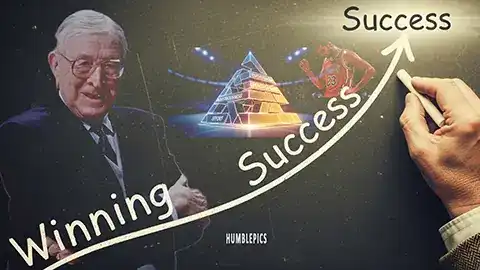
What if the way society measures success is completely wrong? Legendary UCLA basketball coach John Wooden rejected the traditional metrics of power, prestige, and winning. Instead, he engineered a philosophy based entirely on effort and self-satisfaction—a mental framework that practically guarantees peace of mind.
While analyzing the leadership strategies of history’s greatest mentors for the Humblepics Book Collection, I found that Coach Wooden’s approach was radically different from modern hustle culture. We spend our lives chasing job titles and “wins,” feeling like failures if we don’t come out on top. Wooden offered a different, much more powerful definition of success that has absolutely nothing to do with a scoreboard, and everything to do with what you can control.
Redefining Success: The John Wooden Philosophy
1. Why the Old “Success” Doesn’t Work
Long before his record-breaking, championship-filled days at UCLA, Wooden was a high school English teacher. He grew deeply frustrated with the pressure parents put on their children for A’s and B’s, judging a “C” student as a failure. He saw the exact same flawed logic in sports, where alumni judged a coach only on wins, not on the team’s effort or actual improvement.
He knew this was fundamentally wrong. People are not created equal in size, intelligence, or natural physical talent. Expecting everyone to get an “A” or win the championship was not just unfair; it missed the point of human development entirely. He looked up the dictionary definition of success—“the accumulation of material possessions or the attainment of a position of power or prestige”—and flatly rejected it.
2. Creating a New Scoreboard (His Father’s Creed)
Wooden decided he needed a new definition that would make him a better teacher and give his students something meaningful to aim for. He found his inspiration in a simple creed his father taught him on the farm:
- Never try to be better than someone else.
- Always learn from others.
- Never cease trying to be the best you can be.
His father taught him that the effort to be your best is the only thing you can control. Getting obsessed with things you cannot control (like how talented the opposing team is) will only poison the things you can control. From this, he crafted his revolutionary definition:
“Success is peace of mind attained only through self-satisfaction in knowing you made the effort to do the best of which you’re capable.”
3. What This Means For You
Let’s break down exactly why this definition is a psychological game-changer for high achievers:
- It’s 100% In Your Control: You cannot control if a competitor is more talented, if the economy crashes, or if a referee makes a bad call. But you can always control your own effort.
- Only YOU Are the Judge: No one else can accurately judge your success. The world sees your reputation (what they think you are). Only you know your character (what you really are) and whether you truly gave your maximum effort.
- It Ends the Comparison Trap: This philosophy isn’t about beating others. It’s entirely about being your best self. Your success becomes completely independent of anyone else’s highlight reel.
4. The 3 Non-Negotiable Rules
Wooden didn’t just talk about this philosophy; he lived it and built his unstoppable teams around it. He considered himself a teacher first and a coach second. His strict priorities for his players were: 1. Education, 2. Basketball, 3. Social Life (which could never interfere with the first two).
To build character and elite focus, he enforced three simple, non-negotiable rules:
- Never be late.
- Not one word of profanity.
- Never criticize a teammate. (He told them, “That’s my job. I’m paid to do that.”)
He also demanded his players live by his father’s other ultimate rule: “Don’t whine. Don’t complain. Don’t make excuses.”
5. The Journey Is the Victory
Think about this staggering fact: In his entire, legendary career, John Wooden never once mentioned “winning” to his players.
He truly believed that “the journey is better than the end.” He wanted his players to focus intensely on the process of giving their absolute best, every single day in practice. The final score, he argued, was just a natural, mathematical byproduct of that effort. His goal was that if you watched his team in the locker room after a game, you wouldn’t be able to tell from their behavior whether they had won or lost. They could hold their heads high either way.
6. Who is Truly Successful?
When asked to describe his most “successful” players, Wooden didn’t just point to his NBA Hall-of-Famers like Kareem Abdul-Jabbar or Bill Walton. Instead, he loved to talk about bench players like Conrad Burke and Doug McIntosh.
When they first joined the team, Wooden privately thought that if these two ever had to play serious minutes, the team was in trouble. They weren’t naturally quick, and they couldn’t jump well. But through sheer, relentless effort, they maximized every ounce of their potential.
- They became outstanding defenders simply by mastering balance and positioning.
- They became great shooters because they disciplined themselves to only take shots they knew they could make.
Wooden considered these two players just as successful as his superstars. Why? Because they came as close as humanly possible to reaching their full potential. The only question that matters is: “Did you make the effort to do the best of which you are capable?” If the answer is yes, you’ve already won.
Check out our top titles on Amazon!
Wooden taught us that success is peace of mind. However, achieving that state often requires following a set of practical rules. For a breakdown of these rules, read Seven Fundamental Principles for Lasting Achievement.