Yuval Noah Harari: [5 Ideas That Explain the Future]
Yuval Noah Harari’s framework for understanding humanity reveals that our dominance stems from our unique ability to believe in shared fictions. By examining his concepts of the Cognitive Revolution, Dataism, and the impending rise of Artificial Intelligence, we can decode the trajectory of our species from the Stone Age to the digital future.
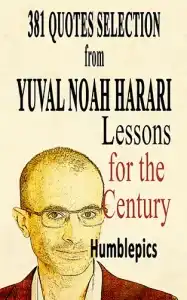
While compiling and categorizing his most provocative thoughts for the 381 Quotes Selection compendium, I realized Harari is not just a historian documenting the past; he is a visionary diagnosing the future. His insights force us to confront uncomfortable truths about human nature, technology, and evolution. Here are the five most powerful ideas I extracted from his collective works that serve as a blueprint for understanding exactly why we are who we are, and where we are going.
What are the Main Ideas of Yuval Noah Harari?
The core philosophy of Yuval Noah Harari is that human dominance is driven by the Cognitive Revolution (our ability to believe in shared fictions like money and nations). His work warns that this dominance is now threatened by the rise of Dataism, artificial intelligence, and the creation of a global “useless class” as humanity attempts to upgrade itself into Homo Deus.
The Future of Humanity: 5 Key Insights from Yuval Noah Harari
1. Idea: The Power of Fiction (from Sapiens)
“Sapiens can cooperate in extremely flexible ways with countless numbers of strangers. That’s why Sapiens rule the world… because we are the only animal that can believe in fictions.”
This is Harari’s foundational concept. What makes us special isn’t our tools or our thumbs; it’s our “Cognitive Revolution.” We are the only species that can invent, and collectively believe in, “fictions”—things that don’t physically exist in nature, like money, nations, human rights, and corporations. These shared stories are the “software” that allows us to build cities, coordinate global trade, and conquer empires.
2. Idea: The “Useless Class” (from Homo Deus)
“The most important question in 21st-century economics may be what to do with all the useless people… The problem is boredom, and what to do with them, and how will they find any sense of meaning in life?”
During my deep dive into his economic forecasts, I found this to be Harari’s starkest warning about Artificial Intelligence. As algorithms become better at almost every cognitive and physical task, the problem isn’t just “unemployment.” It’s “irrelevance.” He warns of a new “useless class”—people who have zero economic or military value to the global system. Finding meaning for this population will be the great political and philosophical challenge of our century.
3. Idea: The New Religion is “Dataism”
“The new religion… says that your one command is to create and consume data… The entire human experience is just a pattern of data… and the algorithm understands you better than you understand yourself.”
Harari argues that we are moving past a human-centric worldview and into a new religion: “Dataism.” This is the belief that the universe is just data flows, and the algorithm is the new god. We are already coming to trust it more than ourselves—think of Netflix recommendations, social media feeds, or Google Maps. The risk is that we will happily and voluntarily hand over our authority, and our freedom, to the algorithm.
4. Idea: The Move from Homo Sapiens to Homo Deus
“We are about to become gods… we will have the power to re-engineer our bodies and brains… The real question is not ‘Will we become gods?’ but ‘What kind of gods will we be?’”
For all of history, our biology has been fixed by natural selection. Now, Harari argues, we are seizing control of our own evolution. Through bioengineering, genetic editing, and AI integration, Homo Sapiens (Wise Man) is attempting to upgrade itself into Homo Deus (God Man). We are seeking to conquer death, manufacture happiness, and design our own descendants. This is the ultimate “power” challenge for our species.
5. Idea: The Only Skill That Matters (from 21 Lessons)
“In the 21st century… the most important skill is to be able to change. To learn and unlearn. You will have to reinvent yourself again and again.”
After reviewing hundreds of his interviews, it is clear this is his ultimate, practical “lesson for the 21st century.” In a world changing this fast due to tech and climate, your static knowledge will rapidly become obsolete. The only skill that matters is mental flexibility. Your ability to let go of old ideas and embrace new ones will be your single greatest asset. You are no longer “learning a job for life”; you must learn how to learn.
More Essential Yuval Noah Harari Quotes on the Future
To further understand the trajectory of humanity, here are additional highlights extracted directly from our complete volume.
Quotes from Sapiens on Human Nature
“Biology enables, Culture forbids.”
“History is something that very few people have been doing while everyone else was ploughing fields and carrying water buckets.”
“A meaningful life can be extremely satisfying even in the midst of hardship, whereas a meaningless life is a terrible ordeal no matter how comfortable it is.”
Quotes from Homo Deus and 21 Lessons
“People are usually afraid of change because they fear the unknown. But the single greatest constant of history is that everything changes.”
“Questions you cannot answer are usually far better for you than answers you cannot question.”
Harari’s work is a powerful, and often unsettling, wake-up call. It forces us to confront the stories we live by and the future we are actively creating, whether we know it or not.
Understand the Future of Humanity
Don’t rely on scattered internet searches. Get the definitive physical collection of Yuval Noah Harari’s most profound insights on human evolution and the future.
Explore Yuval Noah Harari’s Key Quotes & Big Ideas →
Explore our complete digital bookstore collection →
Harari looks at history through a scientific lens, stripping away myths. This approach shares DNA with other rationalist thinkers who challenge supernatural explanations. For a deeper dive into this rigorous scientific worldview, explore Richard Dawkins: Science & Skepticism.