Jane Austen’s Social Satire: 5 Lessons on Love, Class, and Money

Jane Austen is often remembered for bonnets and ballroom romances, but her true legacy is as a master of piercing social satire. By dissecting her commentary on the absurdities of human nature, the class system, and the “business” of love, modern readers can learn profound truths about ego and society.
While spending months curating her novels and letters for the Jane Austen Daily Dose compendium, I realized her wit was never just for entertainment; it was a surgical weapon used to expose the rigid conformity of her era. While her world was one of horse-drawn carriages, her psychological insights into how people behave are entirely timeless. Here are the five sharpest lessons I extracted from her work that remain as true today as they were two centuries ago.
The Wisdom of Jane Austen: 5 Timeless Lessons
1. Lesson: On First Impressions and Ego (Pride and Prejudice)
“I could easily forgive his pride, if he had not mortified mine.”
This is the psychological heart of her most famous novel. Austen shows us that we rarely judge people objectively; we judge them based almost entirely on how they make us feel. Elizabeth Bennet is not initially offended by Mr. Darcy’s pride on its own; she is offended that his pride insulted her. This is a timeless lesson in how our own ego and vanity shape our supposedly “rational” judgments of others.
2. Lesson: The “Business” of Marriage (Pride and Prejudice)
“It is a truth universally acknowledged, that a single man in possession of a good fortune, must be in want of a wife.”
This is one of the most famous opening lines in literature, and it is 100% pure satire. Austen isn’t stating this as a biological truth; she’s mocking the societal obsession with this idea. In her world, marriage was rarely a romantic “choice” but a strict economic necessity for women. This line perfectly satirizes a society that reduced human connection and marriage to a cynical, financial transaction.
3. Lesson: Sense vs. Sensibility (Head vs. Heart)
“Know your own happiness. You want nothing but patience; or give it a more fascinating name, call it hope.”
Austen’s work constantly explores the internal battle between our rational “sense” and our passionate “sensibility.” Her heroines are always trying to find the equilibrium between the two. This quote is a beautiful, practical piece of advice: to find true happiness, you must first have the rational clarity to know what it is you truly want (Sense), and then possess the patience and hope (Sensibility) to wait for it.
4. Lesson: The Dangers of “Knowing Best” (Emma)
“The real evils, indeed, of Emma’s situation were the power of having rather too much her own way, and a disposition to think a little too well of herself…”
Emma is a brilliant psychological study of a likeable, highly intelligent, and completely self-deluded person. Because Emma is so sure she “knows best,” she inadvertently wreaks havoc on the lives of everyone she tries to help. Austen’s lesson here is a powerful warning against arrogance and the savior complex. She teaches us that the person we are most likely to deceive is ourselves.
5. Lesson: On True Independence (Persuasion)
“I hate to hear you talk about all women as if they were fine ladies instead of rational creatures. We are not all meant to be silly.”
In an era when women were legally and culturally treated as ornaments, Austen’s characters fought viciously to be seen as “rational creatures.” Her heroines’ greatest triumphs are never just about “getting the man,” but about finding their own voice and trusting their own mind. This is her quiet, revolutionary feminism: the radical idea that women are, first and foremost, complete, rational human beings.
More Essential Jane Austen Quotes on Love and Society
To further appreciate her genius for social commentary, here are additional highlights extracted directly from our complete volume.
Jane Austen Quotes on Love and Marriage
“There is no charm equal to tenderness of heart.”
“A lady’s imagination is very rapid; it jumps from admiration to love, from love to matrimony in a moment.”
“To be fond of dancing was a certain step towards falling in love.”
Jane Austen Quotes on Satire and Human Nature
“For what do we live, but to make sport for our neighbors, and laugh at them in our turn?”
“Those who do not complain are never pitied.”
“Selfishness must always be forgiven you know, because there is no hope of a cure.”
Jane Austen’s wit is her weapon, and she wields it to expose the truths of human nature. Her lessons on love, class, and self-deception are as sharp and relevant today as they were 200 years ago.
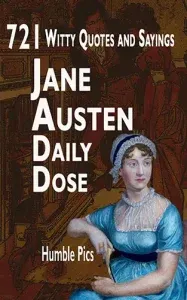
If you enjoyed this analysis, it was inspired by the full collection in our book, Jane Austen Daily Dose: 721 Witty Quotes and Sayings. You can explore all 721 insights in our complete volume, available now in our digital collection.
Explore our complete digital bookstore collection →
Austen used satire to critique the social structures of her time. In a similar vein, Mark Twain’s Timeless Satire exposes the absurdities of American life. However, social critique is not just for novelists; it is also the domain of media analysts, as seen in Noam Chomsky: Media Criticism.