The Choice Paradox: Why “More Options” Is Making You Miserable
The Paradox of Choice: Why “Good Enough” Is the New “Perfect”
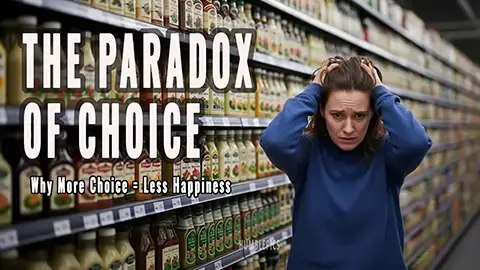
The Paradox of Choice
Why more is less: Understanding how abundance leads to anxiety.
01
Paralysis of Analysis
The Netflix Effect. In a study of 24 jams vs 6 jams, the smaller group sold more. When overwhelmed, people choose nothing.
02
The Agony of “What If”
Opportunity Cost. With 100 options, you imagine the 99 you didn’t pick were better. This psychological cost subtracts from your happiness.
03
The “Perfection” Problem
With 500 options, you expect perfection. “Good enough” feels like failure. The pressure to find the absolute best guarantees misery.
04
Self-Blame
With limited choice, you blame the world. With unlimited choice, if you are unhappy, you blame yourself. “I chose wrong.”
The Way Out
Change your mindset: Maximizers vs. Satisficers
The Maximizer
- • Must have the absolute best.
- • Researches every option.
- • Terrified of wrong choices.
- • Result: Anxious & Regretful.
The Satisficer
- • Has clear criteria.
- • Knows what “good enough” is.
- • Moves on immediately.
- • Result: Happier & Free.
You’ve been there. It’s Friday night. You open Netflix, determined to find the perfect movie. You scroll. You browse categories. You watch trailers.
Forty-five minutes later, you’ve found nothing. You’re annoyed, tired, and you end up re-watching an old sitcom.
Welcome to the Paradox of Choice.
We live by an “official dogma” that’s so embedded in our culture, we never think to question it: To be free, we must have maximum choice.
We believe that more options equal more freedom, which must equal more happiness. More cereals, more jeans, more streaming services, more potential partners on a dating app. More is always better.
There’s just one problem: it’s a lie.
When the number of choices explodes, it doesn’t liberate us. It paralyzes us and, strangely, makes us less satisfied with what we get. Here’s why.
1. The Paralysis of Analysis
This is the Netflix effect. When faced with 24 different types of jam (as in a famous study), most people simply can’t decide. They are so overwhelmed by the options that they choose nothing.
Compare that to a study with only 6 types of jam. People could easily compare, contrast, and pick one.
The Result: The 6-jam display dramatically outsold the 24-jam display. Too much choice doesn’t lead to a sale; it leads to an exit.
2. The Agony of “What If” (Opportunity Cost)
Let’s say you do manage to choose. You buy a new pair of jeans. How do you feel?
If you had only two options, you feel pretty good. But when you had 100 options, your brain can’t help but think about the 99 you didn’t choose.
This is opportunity cost. The “cost” of every choice is the “benefit” of the alternatives you gave up. Your brain torments you with the thought that one of those 99 other pairs might have been slightly better—a better fit, a better price, a better color.
The more options there are, the more “what if” scenarios you’ve rejected, and the less you enjoy the one you actually picked.
3. The “Perfection” Problem (Escalation of Expectations)
When you have only one or two options, your expectation is just to find something “good enough.”
But when you have 500 options, your expectation skyrockets. You think, “With this many choices, one of them must be perfect.”
Now, “good enough” feels like a failure. The “perfect” movie, the “perfect” vacation, the “perfect” soulmate must be out there. This pressure to find the absolute, 100% “best” makes you miserable, because that “perfect” option rarely exists.
4. The Self-Blame Game
This is the psychological dagger. When you have limited options and you’re unhappy with the result, who’s to blame? The world. “What can I do? They only had two bad options.”
But when you have 100 options and you’re unhappy? Who’s to blame?
You are.
The world provided every conceivable option. It’s your fault for not being able to pick the right one. Too much choice doesn’t just make us less satisfied; it makes us blame ourselves for our dissatisfaction.
The Way Out: The “Satisficer” vs. The “Maximizer”
The solution isn’t to get rid of choice, but to change our mindset about it. Psychologists divide us into two groups:
- The Maximizer: This person must have the absolute best. They research every option, read every review, and are terrified of making the wrong choice. They are perpetually stuck in the paradox, and even after they choose, they are haunted by “what if.”
- The Satisficer: This person has criteria. They know what “good enough” looks like. They look for the option that meets their criteria, and when they find it, they choose it and move on. They don’t worry about the “perfect” option they might have missed.
The research is clear: Satisficers are consistently happier, more optimistic, and less stressed than Maximizers.
The secret to happiness isn’t finding the best in a sea of options. It’s the freedom of finding good enough and being content with it.
The cure for the anxiety of unlimited choice is disciplined restriction. You must learn to artificially limit your options to regain your peace of mind, a strategy detailed in our Habits and Focus Guide.