The Architecture of Behavior: 4 Psychological Theories of the Mind
Human behavior is not a mystery; it is a predictable output driven by biological triggers, conditioned rewards, and hierarchical needs. By understanding the core psychological theories of Pavlov, Skinner, James, and Maslow, you can reverse-engineer your own habits and take control of your daily actions.
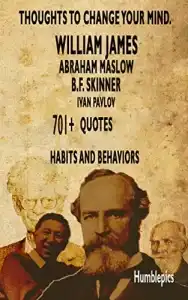
While compiling the 701 Quotes compendium featuring the founders of modern psychology, I noticed a profound, chronological framework hidden across their work. I realized that Pavlov, Skinner, James, and Maslow weren’t just proposing separate theories; together, they inadvertently built a complete, step-by-step “Architecture of Behavior.” Rather than viewing these concepts as dry academic history, I have synthesized my research below into a four-part practical system that explains exactly why we do what we do—and how to change it.
The Architecture of Behavior: 4 Core Theories
1. The Trigger: Ivan Pavlov (Classical Conditioning)
“The conditioned reflex is a psychological phenomenon…”
We start with Pavlov’s famous dogs. He discovered that he could make a dog salivate for a bell, just by ringing it before feeding time. This is “Classical Conditioning.” The key is the trigger (the bell). Our lives are filled with triggers: the “ding” of a text message (the trigger) makes our heart jump (the response). We are all, in a way, like Pavlov’s dogs, conditioned by the triggers in our environment.
2. The Reward: B. F. Skinner (Operant Conditioning)
“The consequences of an act affect the probability of its occurring again.”
While researching Skinner’s original experiments, I found his most critical insight isn’t just that rewards shape behavior, but the timing of those rewards. This is “Operant Conditioning.” The most addictive behaviors in modern society rely on “variable rewards”—where the payoff is unpredictable. Tech designers explicitly use Skinner’s frameworks to build the slot machines in casinos and the infinite scroll of social media algorithms. They are literal “Skinner boxes” designed to exploit our neurochemistry. Recognizing this specific mechanism is your first step to reclaiming your focus from modern technology.
3. The System: William James (The Power of Habit)
“All our life… is but a mass of habits.”
William James was the great synthesizer. He took these theories and made them practical. He argued that we are our habits. He was the first to explain how to build a new habit: launch it with a strong initiative, and never let an exception occur until it’s rooted. He’s the bridge from pure theory (Pavlov/Skinner) to a practical system for self-improvement.
4. The Goal: Abraham Maslow (The Hierarchy of Needs)
“What a man can be, he must be. This need we may call self-actualization.”
So, why should we build good habits? Maslow gives us the ultimate answer. He created the “Hierarchy of Needs,” showing that after our basic needs for safety and love are met, we all have a fundamental, driving need to become our best selves—to “self-actualize.” This is the goal. Our habits are simply the ladder we build to climb Maslow’s pyramid.
More Essential Quotes from the Founders of Psychology
To deepen your understanding of human behavior, here are additional highlights extracted directly from our complete volume.
William James and Ivan Pavlov Quotes on Habits
“The greatest discovery of my generation is that a human being can alter his life by altering his attitudes.” – William James
“Don’t become a mere recorder of facts, but try to penetrate the mystery of their origin.” – Ivan Pavlov
Abraham Maslow and B.F. Skinner Quotes on Behavior
“If you plan on being anything less than you are capable of being, you will probably be unhappy all the days of your life.” – Abraham Maslow
“A failure is not always a mistake, it may simply be the best one can do under the circumstances. The real mistake is to stop trying.” – B.F. Skinner
These four ideas create a complete system: Pavlov’s Trigger starts a behavior. Skinner’s Reward makes it stick. James’s System shows us how to control it. And Maslow’s Goal gives us the ultimate reason why.
If you enjoyed this exploration of the human mind, it was inspired by the full collection in our book, 701 William James, Abraham Maslow, B. F. Skinner, Ivan Pavlov Quotes. You can explore all 701 insights in our complete volume, available now in our digital collection.
Explore our complete digital bookstore collection →
Understanding the mechanics of the mind is only the first step. To see how these biological mechanisms drive our deepest emotions, we must look at The Biology of Bliss and Brain Circuits. However, in the modern world, these ancient circuits are often hijacked by technology, a phenomenon explored in The Digital Paradox.