Become Who You Are: 5 Nietzsche Quotes on Creating Your Own Meaning

Nietzsche’s philosophy is a radical framework for individual responsibility. By declaring the collapse of external moral authority, he challenges us to become the authors of our own values, embrace the struggle of existence, and ultimately “become who we are.”
While meticulously curating and analyzing his aphorisms to compile the 801 Quotes compendium, I realized that Friedrich Nietzsche is often deeply misunderstood. He isn’t a nihilist; he is the ultimate anti-nihilist. His work doesn’t exist to comfort you—it exists to wake you up. Here are the five core concepts I extracted from his life’s work that provide a terrifying but liberating roadmap to creating your own meaning in the modern world.
Nietzsche’s Philosophy: 5 Core Lessons
1. Lesson: On Creating Your Own Meaning (“God is Dead”)
“God is dead. God remains dead. And we have killed him. How shall we comfort ourselves, the murderers of all murderers?”
This isn’t a cry of celebration; it’s a statement of profound crisis. For Nietzsche, the decline of religion meant that the foundation for all Western morality had crumbled. We could no longer look to a divine power for values, meaning, or purpose. This “death” leaves a massive void. His entire philosophy is an answer to the next question: Now that we are free, what do we do with that freedom?
2. Lesson: On Self-Actualization (“Become Who You Are”)
“What does your conscience say? — ‘You shall become the person you are’.”
This is Nietzsche’s core command. He believed most people are a collection of “second-hand” ideas, adopting the values of their family, society, and culture without question. To “become who you are” is a painful, lifelong process. It means questioning everything you believe, shedding the parts of you that are not authentic, and having the courage to embrace your unique, individual potential, including the parts you fear. This lifelong pursuit of authentic potential is a concept deeply explored in modern psychology, as detailed in our breakdown of how your mind works.
3. Lesson: On Embracing Challenge (“Will to Power”)
“That which does not kill us makes us stronger.”
This is his most famous quote, and it’s the simplest expression of his “Will to Power.” Nietzsche did not believe the primary human drive was for happiness, pleasure, or even survival. He believed it was for overcoming. We are wired to seek resistance, to fight challenges, and to feel a sense of power in our own growth. True fulfillment doesn’t come from a life of comfort; it comes from the struggle and triumph of overcoming obstacles.
4. Lesson: On Loving Your Fate (“Amor Fati”)
“My formula for greatness in a human being is amor fati: that one wants nothing to be different, not forward, not backward, not in all eternity. Not merely bear what is necessary… but love it.”
Throughout my analysis of his later journals, I found that this was Nietzsche’s ultimate, most difficult ideal. It’s easy to love the successes of your life, but Amor Fati (Love of Fate) is the grueling practice of loving the suffering. It’s the radical psychological acceptance that every failure, heartbreak, and mistake was a necessary, unchangeable ingredient required to forge you into who you are today. You do not just bear your pain; you weaponize it for your own growth. This approach differs sharply from other philosophical frameworks, which you can see in our guide on what is Stoicism.
5. Lesson: On the Goal of Life (The “Übermensch”)
“Man is something that shall be overcome. Man is a rope, tied between beast and overman—a rope over an abyss.”
The “Overman” (or “Superman”) is Nietzsche’s answer to the death of God. It is the ideal human who has achieved this transformation. The Overman has rejected old moralities, embraced the Will to Power, created their own values, and lives with a joyful “yes” to life (Amor Fati). It is not a specific person, but a goal for humanity to strive for—to move beyond our current state and become something greater.
His philosophy is a call to action—to stop being a passive member of the “herd” and to have the courage to create yourself. Nietzsche demands that we be the artists of our own lives and the masters of our own fate.
More Essential Friedrich Nietzsche Quotes
If you are looking to dive deeper into his radical philosophy, here are additional highlights extracted directly from our complete volume to help you forge your own path.
Nietzsche Quotes on “Become Who You Are” and Identity
“The individual has always had to struggle to keep from being overwhelmed by the tribe. If you try it, you will be lonely often, and sometimes frightened. But no price is too high to pay for the privilege of owning yourself.”
“No one can construct for you the bridge upon which precisely you must cross the stream of life, no one but you yourself alone.”
Quotes on Truth, Perspective, and Overcoming
“He who has a why to live for can bear almost any how.”
“There are no facts, only interpretations.”
“Sometimes people don’t want to hear the truth because they don’t want their illusions destroyed.”
Become Who You Are
Don’t rely on scattered internet searches. Get the definitive physical collection of Nietzsche’s most profound thoughts on life, power, and morality.
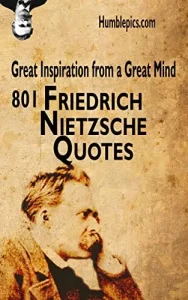
Explore Friedrich Nietzsche’s Selected Quotes & Aphorisms →
Explore our complete digital bookstore collection →
Nietzsche urges us to embrace life, even its difficulties. This stands in stark contrast to his predecessor, who viewed existence primarily through the lens of pain. To understand this philosophical dialogue, read Schopenhauer on Suffering.