Freud vs. Jung: 5 Key Concepts That Shaped Modern Psychology
Disclaimer: This comparison is a simplified overview of the theoretical frameworks proposed by Sigmund Freud and Carl Jung. It is intended for educational and philosophical exploration, not as a substitute for professional psychological diagnosis or treatment.
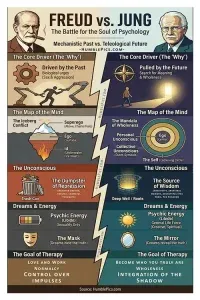
Sigmund Freud and Carl Jung shaped modern psychology, but their fundamental disagreement over human motivation caused a legendary schism. While Freud believed we are mechanistic creatures driven by past traumas and biological urges, Jung argued we are teleological beings pulled forward by a search for future meaning and wholeness.
While spending months curating and translating their letters and lectures for the 911 Quotes compendium, I realized their rivalry wasn’t just an academic dispute; it was a battle over the fundamental definition of the human soul. Sigmund Freud viewed Jung as his intellectual heir, but their relationship fractured over how to map the human psyche. Here is the definitive breakdown I created from my research, comparing their core theoretical differences, followed by the 5 key concepts that define their lasting legacy.
Freud vs. Jung: 5 Key Concepts That Shaped Modern Psychology
1. The Personal Unconscious (Freud)
“The mind is like an iceberg; it floats with one-seventh of its bulk above water.” – Sigmund Freud
This was Freud’s foundational idea. He argued that we are not rational masters of our own minds. Beneath our conscious “Ego” is a vast, hidden “Unconscious” (or “Id”)—a primal, chaotic swirl of repressed memories, hidden desires, and fears. This hidden force, he claimed, is what truly drives our behavior. This “trash can” for repressed, unacceptable desires is unique to the individual’s life history.
2. The Collective Unconscious (Jung)
“The collective unconscious consists of the sum of the instincts and their correlates, the archetypes.” – Carl Jung
This was the idea that caused the “split.” Jung agreed with Freud about the personal unconscious, but he believed there was a deeper layer, one we are all born with. The “Collective Unconscious” is a shared, inherited “software” for all humanity, filled with “Archetypes”—universal symbols like the Hero, the Mother, and the Shadow—that shape our myths, dreams, and core instincts.
3. The Shadow Self (Jung)
“Everyone carries a shadow, and the less it is embodied in the individual’s conscious life, the blacker and denser it is.” – Carl Jung
The “Shadow” is one of Jung’s most practical concepts. It’s the “dark side” of our personality—all the parts of ourselves (anger, jealousy, fear, passion) that we repress because they are socially unacceptable. Jung’s path to wholeness wasn’t to defeat the shadow, but to integrate it—to acknowledge and accept it, thus taking away its power to control us from the dark.
4. The Goal of Life: To Love and Work (Freud)
“Love and work… work and love, that’s all there is.” – Sigmund Freud
Freud was, at his core, a pragmatist. When asked what a “normal” person should be able to do, his answer was simple: “to love and to work.” His goal for psychoanalysis wasn’t to create a spiritual, “whole” person. It was to heal the “neurotic” so they could become a productive member of society, capable of forming relationships and holding down a job. For Freud, the goal was: “Where Id was, there Ego shall be.”
5. The Goal of Life: Individuation (Jung)
“The privilege of a lifetime is to become who you truly are.” – Carl Jung
This shows the profound difference in their philosophies. Jung’s goal was not to make you “normal,” but to make you “whole.” He called this journey “Individuation.” It’s a lifelong, spiritual process of confronting your shadow, integrating the different parts of your psyche, and ultimately becoming the unique, authentic, and “whole” individual you were always meant to be.
Which Framework Do You Need Right Now?
- Think like Freud when: You are self-sabotaging, repeating old patterns, or feel “out of control” due to past habits and childhood conflicts.
- Think like Jung when: You feel stuck, empty, or are actively searching for a deeper purpose, creativity, or meaning in your future.
More Essential Quotes from Carl Jung and Sigmund Freud
If you are looking to understand the profound differences between these two titans of psychology, here are additional highlights extracted directly from our complete volume.
Quotes on the Differences Between Freud and Jung
“Unexpressed emotions will never die. They are buried alive and will come forth later in uglier ways.” – Sigmund Freud
“Until you make the unconscious conscious, it will direct your life and you will call it fate.” – Carl Jung
“Out of your vulnerabilities will come your strength.” – Sigmund Freud
“I am not what happened to me, I am what I choose to become.” – Carl Jung
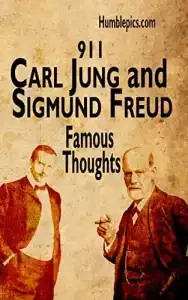
If you enjoyed this exploration of their powerful ideas, this analysis was inspired by the full collection in our book, 911 Inspirational Quotes from Carl Jung and Sigmund Freud. You can explore all 911 insights in our complete volume, available now in our digital collection.
Explore our complete digital bookstore collection →
While Freud and Jung debated the structure of the unconscious, our internal world is also shaped by external language. As discussed in What Our Language Habits Reveal, the words we choose directly influence our cognitive structures. This connects deeply to The Soul’s Anatomy, where we examine what remains when our psychological defenses are stripped away.