The Opposite of Depression Isn’t Happiness. It’s Vitality.
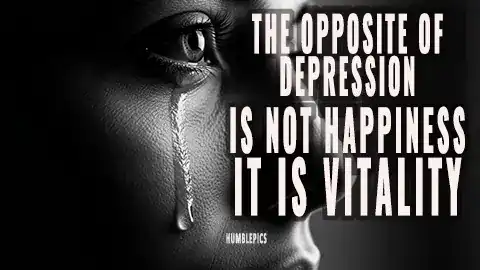
Society often mistakenly views depression as mere sadness, assuming the cure is simply to “find happiness.” However, clinical psychology and the lived experiences of millions reveal a much darker reality: the true opposite of depression is not happiness, but vitality. When vitality vanishes, the simple act of existing becomes a monumental chore.
While researching the psychological frameworks of resilience and the seminal work of author Andrew Solomon for the Humblepics Book Collection, I realized that our cultural understanding of depression is dangerously flawed. We like to think we’re tough. We believe we’re the kind of people who can simply survive hardship through sheer willpower. But depression doesn’t care how tough you are. Here is an exploration into the anatomy of this illness, the lies it tells, and the strange, quiet path toward reclaiming your vitality.
When “Happy” Fades: What Depression Teaches Us
1. The Weight of Being
When you are in the depths of a depressive episode, the simplest daily tasks feel like the Stations of the Cross. Seeing a flashing red light on an answering machine brings a wave of absolute dread. Even the basic biological act of eating—getting the food, cutting it, chewing, swallowing—feels like a monumental, exhausting effort.
The worst part? You know it’s ridiculous. You know millions of people are eating lunch or taking showers without a second thought, but you are trapped, unable to figure out how to do it yourself. You feel less, think less, and do less.
Then, the anxiety can arrive. It is an all-consuming, constant sensation of being afraid. It feels like that gut-lurching, half-second slip on a patch of black ice, but stretched out to last for six months. It is a pain so consuming that you don’t necessarily want to die, but you feel that the act of being alive is simply too painful to endure.
2. The Lie That Feels Like Truth
This is the most insidious psychological trick the illness plays: It convinces you that it is not a mood, but the objective truth.
You don’t feel like you’re wearing a “gray veil” that is unfairly coloring the world. You feel like the naive “veil of happiness” has finally been lifted, and now you are seeing brutal reality for what it actually is.
The “truths” it tells you are highly delusional (“No one loves me”) mixed with unsettling, bleak existential insights (“No matter what we do, we’re all just going to die”). It makes you marvel that anyone can know these stark existential facts and still manage to casually decide what to have for breakfast.
3. The Family Secret
When treatment begins—whether through medication, therapy, or both—a new identity crisis emerges: If I’m not the “tough” person I thought I was, who am I? Does medication make me more myself, or someone else entirely?
We desperately want to know if the problem is strictly chemical or deeply psychological; if the cure is a pill or a philosophy. The reality is that modern science isn’t advanced enough to separate them. Depression is braided so deeply into our neural pathways that it is impossible to cleanly untangle from our personality.
Because of this identity crisis, we hide it. Depression becomes the “family secret that everyone has.” We keep it silent, but keeping it in the dark only gives the illness more power.
4. The Path Through: How to Find Vitality
So, what actually creates resilience? It is not denial.
The people who try to deny their experience—who shut the depression out and refuse to look at it—are often the ones most enslaved by it. Trying to forcefully lock the door only strengthens the monster waiting on the other side.
The people who fare better are those who can tolerate the fact that they have this condition.
Recovery, then, is a strange and non-linear process. It is realizing that if a treatment makes you feel better, “then it’s worked,” even if that treatment is as simple as making little things from yarn. It is learning what poet Maggie Robbins realized: that the emotional needs you have—the things you desperately need from others—can become your “greatest assets” when you finally learn to give those things to yourself.
5. Clinging to Joy
You can learn to love the lessons of your depression. Not for the pain it causes, but for what it teaches you about the human condition.
It teaches you how unimaginably large an emotion can be—that a feeling can be more real and overwhelming than any logical “fact.” This profound experience with darkness ultimately allows you to experience positive emotions in a much more intense, focused, and grateful way.
”I hated being depressed, but I love it now because it forces me to find and cling to joy.” – Andrew Solomon
The opposite of depression is vitality. Even on sad days, life can still be vital. The ultimate goal is to decide, every single day, to cleave to the reasons for living. That, in itself, is a highly privileged rapture.
Explore our complete digital bookstore collection →
Exploring the soul often leads us into the deepest territory of the unconscious. The two great pioneers of this field had very different maps for this territory. To understand these conflicting psychological maps, we must examine the core differences in Freud vs Jung Concepts.